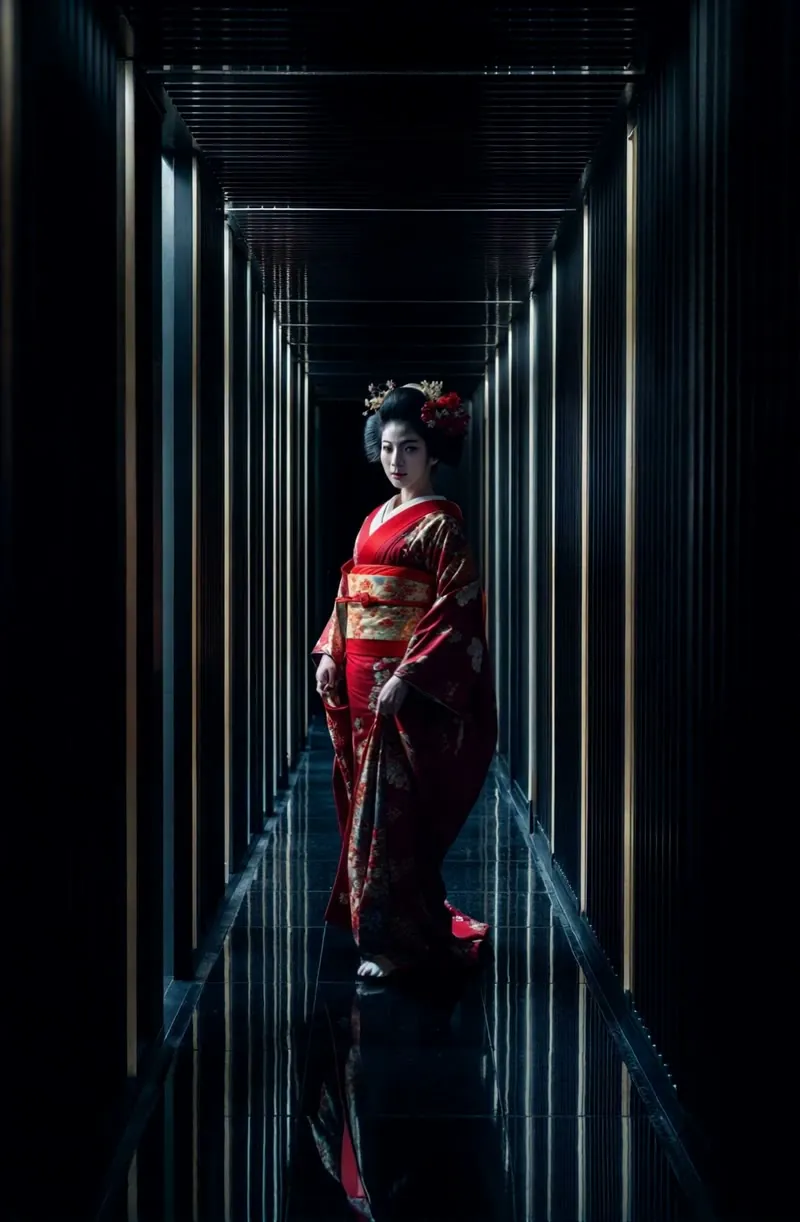
At +81 in Brisbane’s West End, the corridor to the bathrooms ends in a screen. I created a moving-image artwork for it that gives the illusion of a traditional geisha standing at the end of the passage, turning and walking towards the guest.
The idea was developed in collaboration with designer Alexander Lotersztain, whose interior treats every step of the guest’s journey as part of the experience. Monique Kawecki of Champ Creative curated the venue’s artisan tableware and glassware.
1 film
Geisha · 0:10 · Silent
Digital art, 3D and AI.
The geisha, the corridor and its light were built by combining digital art, 3D and AI. Repeated frames and reflections extend the space beyond the wall, while the red kimono holds the eye in the cool, dark setting.
These stills come directly from the ten-second animation, tracing the figure from a distant silhouette to a close encounter.
3 images
In the press
“I just want to create something that is memorable.”
Alexander Lotersztain on +81, in Style, July 2026, with the full interview below.
Selected reading & credits
Part of a larger story.
Independent coverage of the venue, its design and the people behind it.
Style · The artwork in context
Natalie McGowan’s interview with Alexander Lotersztain places the digital geisha within his approach to experiential design, crediting Rodrigo Rabaco for the artwork on the way to the bathrooms.
In her guide to Brisbane, Monique Kawecki describes Aizome Bar’s intimate, indigo setting and Champ Creative’s work curating and sourcing artisan-made tableware and glassware from Japan.
Derlot’s +81 was shortlisted for Hospitality Design in 2025. The project entry explores the relationship between Japanese hospitality, handcrafted elements and the sensory character of the interior.